Showing posts with label D100. Show all posts

Sunday, March 4, 2012

The Mall of Doom Review

This review is for an adventure supplement for "The Mutant Epoch". I previously reviewed the RPG this adventure goes with here. This will not be a very in-depth review because if I go over too many details it will spoil the adventure for players. I will give my thoughts about it.  The adventure takes place in a small town. The townspeople ask the PCs to help investigate a string of suspicious kidnappings. This leads the PCs to an ancient shopping mall filled with monsters and sick horrors. This is a dark module and not recommended for young children if you're wanting to get them into gaming. I really liked it because it shows how desperately this world needs heroes.

Like "The Mutant Epoch" the art in this book is amazing and done by the author himself. Black and white art throughout and each picture matches the text to help describe what is going on. The cover is full-color and shows off some mutant PCs facing off against a horde of baddies. My copy has slightly smaller dimensions than the core rulebook. It isn't as tall or wide. In the top-right corner it says "Muli-Path Adventure Module". This is because it plays out like a "choose your own adventure book", giving the GM multiple logical options depending on the events the PCs triggered, or the direction the story is going in. This makes the adventure less likely to be ruined by the PCs taking a path that wasn't expected and keeps the adventure from becoming rail-roaded. Players aren't forced into only moving one direction.

Normally I'm not very fond of pre-made adventures because they're either too predictable or don't take into account of the players going in a different direction. This adventure could be played in multiple ways with multiple outcomes each time. This is also a tough challenge for players. The game recommends each player have two or three PCs rolled up. I think it would be wise to take their suggestion. I'm not going to get into specifics but this adventure is scary, brutal, and perfectly fits how the genre should be played. There's also one new weapon and creature that are very powerful. Of course there's some new pre-made NPCs and maps.

This is a great first supplement for "The Mutant Epoch" and I highly recommend this adventure. This is good for both novice and veteran GMs because of the ideas and tips it has in it. This is also good if you haven't had experience running a post-apocalypse game, or ran games that focus on combat rather than survival. This will challenge players mentally, putting them in bad situations and forcing them to think. You can order the print copy here and the PDF here.

Tuesday, February 28, 2012

The Mutant Epoch Review

I first discovered this game through tetsubo57's YouTube video review. I never had a mutant post-apocalypse RPG in my collection prior to this game. I sadly missed out on "Gamma World" and "After the Bomb" when they first came out, but I acquired them on the used market after I got "The Mutant Epoch" so I could have a better idea of the genre. From my reading, "The Mutant Epoch" takes a lot of the ideas from previous post-apocalypse RPGs and puts them in a modern and more complete rule system with its own flair added in.

The physical book is 244 pages so it covers a lot of rules and information that rules-lite games can skip out on. The author is also the publisher and illustrator. This is his own game and vision all the way. I really liked the artwork. There's black and white illustrations that go with the text on every page. The cover is full-color and shows off some of the character types that can be played. I know the author also sells graphic designs and he is a very talented artist. This book is better than what some companies with large development teams can do. If you're the type of person who likes visual aids you will appreciate the artwork in this book.

For those who don't know, post-apocalypse settings take place in the far future after society has collapsed. For whatever reason be it radiation, genetic engineering, evolution, etc. large populations of lifeforms on the planet are mutated. This is of course sci-fi and science fantasy and not grounded on real science. There are a variety of mutants and mutations in this setting. Most towns are small, independent, fortresses, who are fearful of horrid mutants. Buildings of today are the ancient relics in this setting. Humans own most of these towns and won't let just anybody in. This is because pure humans have inherited wealth but are severely under-powered compared to the other character types. Pure humans also see themselves as nobles and the creators of some of the other types so they're just jerks to everybody else. Because of the society collapse the world is ran like the dark age feudal system rampant with prejudices.

Pure stock humans are rare and of the highest social caste. Some of the other character types were created by humans to be slaves and servants. Bioreplicants are synthetic humans that are very similar to humans but utilize the human body more efficiently for specific tasks. Bioreplicants are engineered by machines without family and grow up in a life of servitude. Clones are also similar to humans but unlike bioreplicants, they're just copies of humans and not created from scratch through genetic engineering. Clones blend in human societies better than the other non-humans but were still raised to be servants. Trans-humans are evolved humans. Trans-humans are flawless and regard themselves as the best at everything. Though human-like they don't blend in human society very well because of their claimed superiority over humans. Cyborgs are humans with technological implants to overcome human limitations. Cyborgs were designed to do specific tasks for their masters. Man meets machine. Cyborgs can be extremely powerful if fitted with combat implants. Ghost mutants are mutants that appear human. Ghost mutants are not as powerful as the other mutants but they usually have various psionics and immunity powers. Ghost mutants blend in human society better than other mutants but because they're mutants they tend to sympathize for the mutants who are cast out of society. Mutants are the most common type in the world. They vary from degrees of mutations. The more mutations the more powerful they are but the more they stick out to humans. Mutants can be a real powerhouse even with a couple flawed mutations and the most fun to play with. Bestial humans are anthropomorphic animals. They're the result of genetic engineering that was done on animals and became their own species. They have different natural abilities depending on the species of animal they derived from. Also depending on the species bestial humans may or may not be socially accepted. Spider people are more feared than dog people. Cow people are at high risk of being eaten. Having human or human looking companions will help some bestial humans gain access to human towns.

The core mechanic is a "roll under" d100 percentile system, which is an improvement in my opinion over the AD&D system in "Gamma World" and the Megaversal system in "After the Bomb". I know it's probably a bad idea to compare these games against each other in a review, so I'm not gonna dwell on it. If you're curious how a d100 system works just look at my previous reviews where I explain that mechanic in more detail. This is it's own system, while it is a d100 core mechanic, character creation, combat, and character advancement work differently than in the BRP system. D100 systems are my favorite because they're robust and simple to use, so I have no complaints. When skills are being tested dice rolls are compared against a hazard table. I wasn't a fan of that at first because I didn't think it was streamlined but it is a good tool for GMs. They can adjust the difficulty so stronger players are challenged without making tasks too difficult. My impression of it is that it will make a good balancing tool, which a game like this needs because players can vary drastically in power.

What really stands out about this game and is probably the most talked about is the character creation rules. A mutant post-apocalyptic setting probably has the most diverse characters interacting with each other and this system reflects that. Although there's a point buy alternative, the core is random and I like that much better because I like the diversity it generates. If every player had their way the would try to create the perfect character archetype they want to play but that isn't realistic especially for a setting like this. The teams will be made up of ragtag misfits with flaws and broken backgrounds. Everything from the character type, caste, job, skills, mutant abilities, cyborg implants, starting gear, age, even which hand is dominant is covered in the character creation system. You can walk in without any idea at all, roll against the random charts, and have a complete fleshed out character. This can almost be considered a game in and of itself. Just know that this is a dark future and there's a high chance your character will have a troubled past. Slave, poor farmer, prostitute, criminal. You're not likely to be a super soldier or wealthy scientist.

There's a list of mutant powers, cyborg implants, and mutant creatures and they're perhaps the most coolest things I have ever read in a RPG. There's almost everything that can be thought up. All are useful, most have variations, and all detailed with rules on how to use them. They include by not limited to acid blood, beam eyes, bladed limbs, claws, electric pulse, multiple limbs, multiple heads, spikes, ballistic-proof skin, tentacles, climbing suckers, night vision. There's a lot. Same with cyborg implants. Alloy razor claws, armor, force fields, communication implants, hydraulic legs, power arm, pincers, built-in computers, optic enhancements, air filters, hidden lasers and guns. There is so much more. The mutant creatures mostly consists of animals, plants, and insects that have been genetically modified to be giants that are intelligent, multi-headed, multi-clawed, with stingers and fangs. Some creatures are humanoids that were genetically engineered for war. This is also where the artwork I mentioned before really came through for me. Just about everything listed has a picture to visually give you ideas. Even frogs want you dead in this game.

The combat system is interesting. If a character can make multiple attacks in a single round they can make multiple attacks like normal or combine them into one all-out powerful attack for that round. There's a greater risk of missing because it's only one attack but with a higher damage potential. I also like how all the dice are used for damage so every die gets used, even d20s. Even though it's a d100 system, I find the full dice spectrum gets used more than in other d100 systems. When attacking the result (Strike value or SV) is compared against the targets defense value (DV), which is a combination of the targets armor and evading abilities. If the SV succeeds the DV then damage dice are rolled. The amount of damage one can take is determined by their endurance. If the damage taken succeeds their endurance they're unconscious or possibly slowly taking more damage from dying. How much negative damage that can be taken before death depends on their willpower and if the character also took some non-lethal stun damage.

The items and weapons in this game are both modern day and futuristic. Ammunition and power packs are precious resources like food and water. A lot of melee weapons and armor are improvised mundane items, which I thought was neat and makes sense for the setting. Aside from regular guns like we have today there are some that feed multiple types of ammo, improved high-caliber ammo, and laser weapons, showing that the weapon technology has continued to improve since our time. There's also lost futuristic technology and survival gear. High-tech computer systems are considered precious relics and luxury items. Also most mutants, bestial humans, and cyborg have natural or built-in weapons and armor as well. Even if unequipped they'll still have a way to fight and block attacks.

There is just so much sci-fi goodness in this book. Robots, androids, vehicles, you name it. The androids also have their own caste systems depending on the model and job assignment is was designed for. They're extremely powerful enemies if being utilized for combat. They aren't playable characters yet but I think that's OK. The game isn't really meant to be played as machines or mutant plants like in Gamma World but I can see why people would like to play them. The author did say rules to play those character types may be included in future supplements. There's already quite a bit of supplement material for this book. If you use the passcode on the inside cover you'll get access to free PDFs by the author for extra creatures, NPCs, items, optional rules, and GM tools. There's a monthly magazine that you can subscribe to that has more cool things in them as well. There's also an adventure supplement called "The Mall of Doom" which I will post a short follow-up review on because I don't want to ruin the adventure.

The Mutant Epoch can be picked up on Amazon, Lulu, and RPGNow. The website for the company can also be found here This is probably the best in-print RPG in the mutated far future, post-apocalypse genre and maybe even the best in the genre of all time. The setting, rules, creatures, technology, and characters are all things I like and I know a lot of people like this stuff too.

Saturday, February 12, 2011

The Call of Cthulhu Short Review & Thoughts

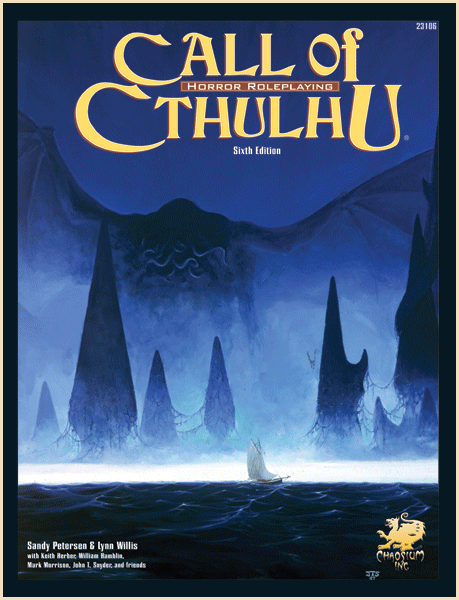
Call of Cthulhu is a RPG that's been around since the early times of tabletop gaming. Released in 1981 by Chaosium using their BRP D100 rules system. I briefly covered BRP in my OpenQuest review but CoC uses the full version of BRP. If you're unfamiliar with BRP I recommend checking out my OpenQuest review here. The skills and careers are based during the 1930's era but can be played during almost any time period. GMs are called Keeper of Forbidden Knowledge and players are Investigators. The appeal of CoC isn't really the rules but more for the setting although I think the rules go well with the setting.

Full BRP is slightly different than OpenQuest. The major differences are character creation and advancement. First players roll dice to determine their attributes. Characters choose a profession to determine what skills they start off with. Think of them sorta like a template for the type of character you wanna play. You can start from scratch I suppose but this might cause some balance issues between characters and slow things down. To advance skills players check off skills they've use. After a session players roll D100. If they roll higher than their current skill percentage the skill goes up. So the more players use skills the higher they advance and the harder they are to advance later on. There are more detailed difference but these are the biggest two.

Based on the writings of H.P. Lovecraft the Cthulhu mythos is a sci-fi horror setting. Ancient alien gods are worshiped by cultist. The gods don't care about humanity but are intertwined and play with humans like toys. This is a very dark and grim setting where it's very easy to die if players aren't careful. The players play as investigators who have some ties with the town and go snooping the weirdness going on. The games usually start off being subtle and evolving more evil as they go on. Characters have a sanity score and the more they know about the mythos they have to roll to keep their sanity. If they fail they'll lose sanity. As characters lose sanity the players start to lose control of their actions by gaining phobias and mental illnesses. Eventually going completely insane and become controlled by the Keeper. This game has a ton of support from Chaosium with several supplements and modules. Currently in the 6th edition but I think technically it's in it's 9th. Because CoC uses BRP little has changed through the decades with the rules. Each edition is more like a reprinting with some slight changes to refine the setting. A supplement from the 80's will work just as good presently.

CoC isn't a game I play as often as I'd like. I love the setting and making adventures but it requires participation from the players. More so than most RPGs. If players are too active they will get into danger and die. Too reserved and they don't get into enough trouble to go deeper in the mythos. This game requires a sweet spot that is hard to meet for most of my groups. I think it has to do with the setting. In Lovecraft stories the characters weren't aware they were in a horror story. They acted just as they would normally any other day. They knew something weird was going on but they didn't expect monster worshiping cults. In the RPG everyone is aware they're in a horror story. Players need to be good at separating what they know with what they're characters know. In a few play troughs it gets better but it's something to be aware of. There is setting for CoC that sorta helps resolve this called Delta Green. Although still a horror game I find it's easier for players to get into that "sweet spot" and there's more mystery. Players aren't as aware of what to expect. I plan on review Delta Green is going to be a future post so check back later. :)

Tuesday, February 1, 2011

OpenQuest Review

I played OpenQuest up until I started my BW and BE games. Even before I got a hold of the final version of OQ I played the free version for over a year and it's derivatives even longer. OQ is in a nutshell a simplified and streamlined retro-clone of RuneQuest. Basic Role-Playing, RuneQuest (any version), Stormbringer, Call of Cthulhu, Elfquest, Ringworld, Pendragon, and a few other games all use basically the same D100 percentile dice mechanic called BRP. I've played these games a lot prior to OQ and when it comes to playing BRP in a fantasy setting I think OQ is the best because of it's simplicity. OpenQuest is published by D101 Games. The book is 188 pages long with black & white artwork throughout. The cover is very eye catching as you can see up top. The presentation is great. It has a index but the table of contents is easier to use for looking things up in my opinion. Though you won't be needing to refer to the book a whole lot in play it's nice that if it were to be needed quick research can be done.

D100 is simple enough already. You roll 2 ten-sided dice. One is tens place (00-90) and the other is ones (0-9) and you try to get a result under your skill level. The lower the result the better. So if you have a skill of 80% you just gotta get under 80. A skill at 30% means you gotta get under 30 and that's harder to do. 1's (00 on tens and 1 one ones) are critical successes and 100's (00 on tens and 0 or ones) are fumbles. In d100 the result of the tens die tends to be the most important result. The ones is just if you're barley on the edge, opposing sides got a tied result, and to determine if you got a critical or fumble. In OpenQuest there are modifiers but you don't have to keep up with a bunch of little ones. All modifiers are either +/-25% or +/-50% with the exception of some spells that are +/-10%. This gets rid of a lot of micromanagement that plagues RPGs and can sometimes be a hassle in percentiles.

Character creation is simple but different than RuneQuest. Gone are lifepaths. I don't know if this was done for simplicity or because of the way skills are laid out. Maybe both. It's a good different alternative from what is common in BRP. Each character has starting characteristics. There's eight characteristics each with a base point value of 8. Strength, constitution, dexterity, size, intelligence, power, and charisma. Players have 30 points to spend on them. All have a maximum value of 18 for humans. Characteristics can be reduced lower than 8 for some additional spending points but have set minimum values. If a player has a concept in mind this is the best method. There's a dice rolling method too if a player wants to go completely random. Attributes are second values that are directly effected by characteristics. Damage modifier, hit points, major wound level, magic points, and movement rate. There are different character creation rules if a player wants to play a non-human. It's very easy to use any non-human as a player character. From the common elves and dwarves to monsters. I played a game where the players were in a orc war-band. 2 were orcs, 1 goblin, and the other 2 were different types of undead. It's a simple and robust system.

Skills are also different than other d100 games. The skills are more broad to again cut-down on micromanagement. This is classless game but the skills are almost like career fields. This makes the characters feel more experienced and like they took an actual trade rather than picking up random skills. I like this approach because it's still more robust than classes but less hassle dealing with specific skills. When a skill is raised it's raised in increments of 5% to cut down on math and for simplify. It would be very easy to add your own skills if something you want can't be used with the skills given. I think this modification to skills is what lead to most of the major mechanical differences from RQ/BRP.

Magic is different if you're not familiar with RQ. Magic is open to everybody. Now that's easy to change if you don't want that but it was this way in RQ and it's that way in OQ. It's not bad though. It's common magic and it's fairly simple stuff. A character with just common magic isn't going to be a spell slinging wizard. It makes sense though. In the real world anybody can be a fighter but unless you specialize in fighting you're not gonna be better than average. In OQ there's Sorcery and Divine magic. These are the specialized magic fields and where more powerful spells are but they have more requirements to meet. Shamanism and the spirit combat rules to go with Shamanism are also included. So there's a lot of variety in this game when it comes to fantasy magic all using the simple and robust OQ philosophy. Keeping up in RQ tradition is the influence of religions and cults. Different gods and practices give different skills, spells, and special abilities but also require their followers to do things to appease them. Cults are more influential on Divine magic but they effect the social views of all characters and the setting one way or another.

Combat is fast and gritty. Players have a list of different combat actions. Defense, close, ranged, and unarmed all have a set of actions. When fighting the opposing sides roll. The one with the lowest roll wins and is successful with their action. If taking a defensive action the offensive attack is avoided. If taking offense they roll damage dice according to their weapon and the if the opposition is wearing armor a fixed value is subtracted from the damage. OQ uses a fixed hit points system as opposed to hit locations like most BRP games. If a character receives damage that is more than 1/2 of their original hit points in one hit the victim has to roll for a critical wound which will be nasty. Mangled limbs, loss of a limb, brain damage, eye torn out, and broken bones. These are like the Stormbringer 5th edition rules and fit right in with the simple minimal counting approach of OQ. I really liked this change and it made combat brutal without being a chore like how hit locations can be. Fantasy settings tend have a lot of fighting but in OQ it shouldn't be the only option characters have to solve a problem.

Improving a character in OQ may seem a bit slow than other RPGs but keep in mind characters start out being proficient to begin with. This might just be my opinion because BRP games never really focused on maxing characters out so much they essentially just become stat blocks with no personality or drive. There's similar rules in OQ like the previous mentioned Burning Wheel called motives. These are different than beliefs but their purpose is the same overall. To give the characters goals to accomplish and to be rewarded for them. It's a different improvement method than most BRP games but just as effective. It's more story-driven in OQ and I think that was the author's intent. Players can practice skills outside of questing to speed improvement up. There's also hero points which allow the player to change the situation they're in through plot editing. 

There's more rules for ships, mental damage, travelling, mounts, objects, healing, poisons, disease, encumbrance, suffocation, thirst and starvation, falling, illumination, and burning to death. These are all towards the back and are only needed when the situation comes up. They're all simple to apply and can make a situation more interesting in gameplay. In the back is also the monster list and the information needed to use them as characters. There's also ways to figure up random items or treasure they will have if defeated. There's about 40 in total (counting the elemental separately) and an animal list with another 25. So the selection is really good and making your own creatures here won't be a problem. (I'm glad to see the Durulz from Glorantha here ;)

There's a pre-made setting called the Empire of Gantan. It's a cool base for a setting that GMs can build on. It's like a fantasy Byzantine empire. Religion, conquest, politics, combined with magic and monsters. It's clearly inspired by Gloarantha and I think it's purpose was to make OpenQuest easier to tie in with that setting or to be built on by GMs. It comes with some sample adventures to show off the system and to give a feel of the setting. Not bad for starting out if you're just trying this game out from scratch or need some quick ideas.

You can get OQ at http://d101games.co.uk/books/openquest/. The publisher uses Lulu print on demand so if you order it will take about a week longer than most orders because of the time needed for Lulu to get around printing and binding. OpenQuest is a simple and robust game out-of-the-box but easy enough to customize and add in your own stuff. It's very easy to add RuneQuest and BRP rules if something from them fits your campaign better. This goes along great in the family of D100 games because of it's different twists on the system.